
Cassie Therrien-Abell
The Best Workout Plan for Women on GLP-1 Medications
Exercise
.webp)
GLP-1 medications work. The weight comes off. But there's a catch nobody really loves to talk about: a significant chunk of what you lose can be muscle mass if you're not actively fighting to keep it. And for women especially, that has consequences that go well beyond the scale.
Here's what your workout plan should actually look like while you're on a GLP-1.
Honestly, for a lot of people at the start? Yes. Walking is a legitimate workout, not a consolation prize you do when you're not "really" exercising.
There's no magic in 10,000 steps. That number came from a Japanese marketing campaign in the 1960s, not a lab. (Lee et al., 2019, JAMA Internal Medicine) You don't need to hit some arbitrary target. You just need to increase from wherever you currently are. At 3,000 steps a day? Try for 4,000. That's it.
Once you're seeing steady, sustainable weight loss week over week, stay there until things plateau. Then you can nudge it up again.
One thing worth doing: walk after meals if you can, even just 5-10 minutes. There's solid recent research showing a short post-meal walk brings blood sugar back down quickly. (Buffey et al., 2022, Sports Medicine) GLP-1s already help regulate blood sugar, so pairing that with post-meal movement is putting a hat on a hat, in the best way.
Prefer cycling? Swimming? Great. The specific activity doesn't matter. What matters is getting your heart rate up into Zone 2 and doing it consistently. Zone 2 is the zone where you can hold a conversation, but it's not effortless. That range is where most of the cardiovascular and metabolic benefit lives for weight loss. (Mandsager et al., 2018, JAMA Network Open)
Any time you lose weight quickly, you risk losing muscle alongside fat. With GLP-1 medications specifically, this is well-studied enough that most prescribing doctors bring it up alongside protein intake. (Wilding et al., 2021, NEJM)
Muscle loss matters for a few reasons. First, muscle is metabolically active, meaning the more you have, the more calories your body burns at rest. Lose the muscle and you make long-term weight maintenance harder. Second, for women over 40, there's the bone density piece. Studies are showing that people on GLP-1 medications who aren't exercising are at higher risk of bone-related injuries and osteoporosis. (Biancolin et al., 2023, Obesity Reviews) Strength training does the opposite: it signals your bones to stay dense and your muscles to stay.
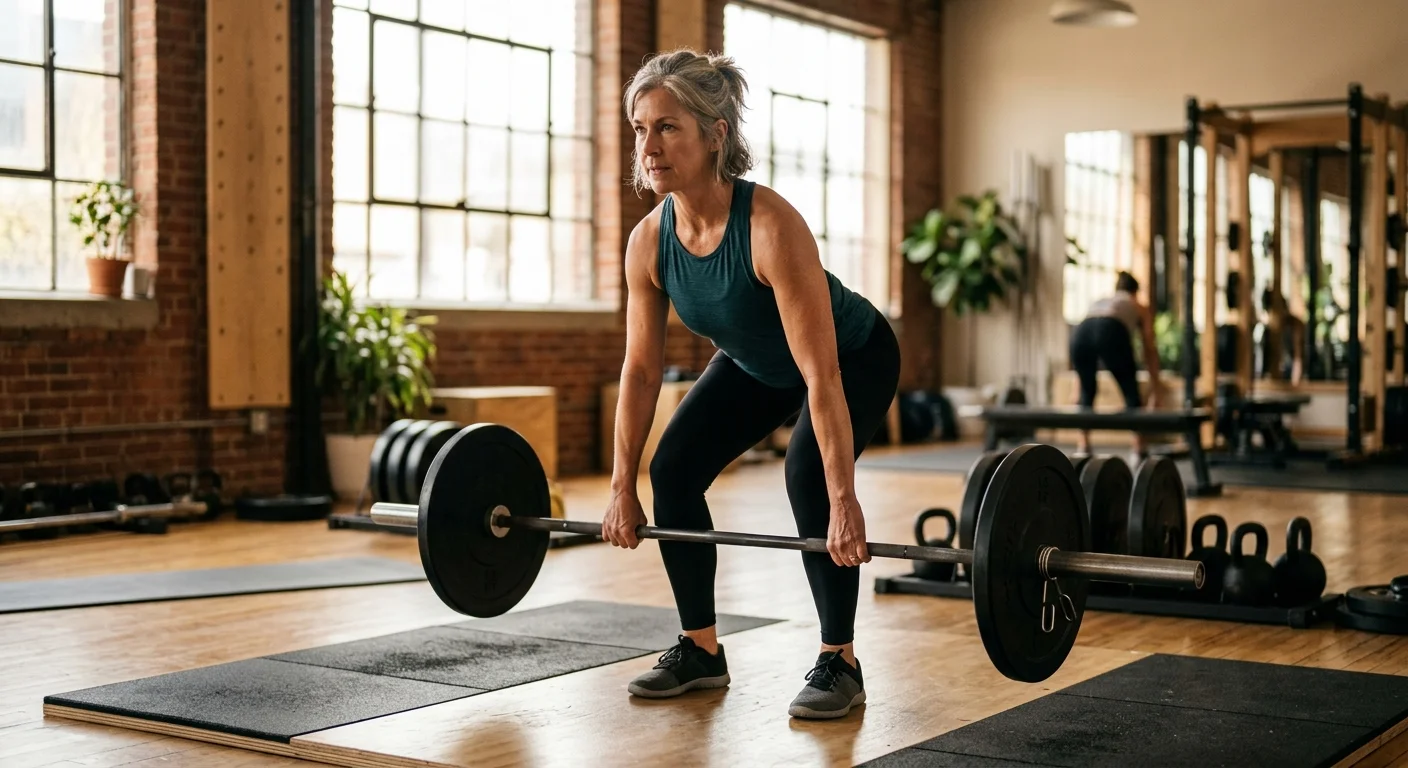
You don't have to lift heavy. You just have to move against resistance. Bodyweight counts. Resistance bands count. The goal is simple: use your muscles often enough that your body gets the message that it still needs them.
Aim for at least two sessions a week, ideally three. That's the minimum frequency to send that signal consistently. (ACSM Position Stand, 2019) For a deeper look at how to structure those sessions specifically for GLP-1 users, see our complete strength training guide.
This is one of the most common things we see get skipped over in GLP-1 workout guides: the medication suppresses your appetite, sometimes drastically. That's the point. But it also means you can accidentally undereat to a degree that makes your workouts harder than they need to be and accelerates muscle loss.
You don't need to force food. But you do need to be intentional about getting enough protein. A general target of 0.7 to 1 gram of protein per pound of bodyweight is a solid starting range if you're strength training. (Morton et al., 2017, British Journal of Sports Medicine) If your appetite is suppressed and you're struggling to hit that, prioritize protein at every meal over other macros.
If you have a workout planned, try to eat something small beforehand, even if you're not hungry. Even half a banana or a small handful of nuts is enough to keep your energy from tanking mid-session. If you're wondering whether supplements can help fill that gap, it's worth knowing whether pre-workout supplements are safe on GLP-1s before adding them in. This isn't about rigid rules. It's about not going into a strength session running on empty and then wondering why everything felt awful.
| Situation | What to do |
|---|---|
| Not hungry before a workout | Eat something small anyway: a piece of fruit, Greek yogurt, a handful of nuts. Even 100-150 calories is enough. |
| Struggling to hit protein goals | Prioritize protein at every meal. Greek yogurt, eggs, cottage cheese, a simple protein shake if needed. |
| Feeling dizzy or weak during workouts | Back off intensity and check in with your prescribing doctor. Electrolytes can also help, especially early on. |
| Nausea on workout days | Shift to lighter movement (walking, gentle stretching). Don't force a hard session on a rough side effect day. It also helps to think about when to exercise around injection day so you're not scheduling hard sessions when side effects tend to peak. |
Yes, and most generic workout guides leave these out entirely.
Pelvic floor: A lot of women, especially those who've had kids, deal with pelvic floor dysfunction and don't realize it's affecting their training. Jumping, heavy lifting, and high-impact cardio can all aggravate symptoms. If you're leaking, feeling pressure, or having any discomfort, that's your body flagging something worth addressing, not something to power through. Working with a pelvic floor PT alongside your fitness routine is worth it. In the meantime, lower-impact options like cycling, walking, swimming, and resistance training with controlled breathing are all better starting points than jumping straight into HIIT.
Joint sensitivity: Women are generally at higher risk for certain joint injuries, partly due to hormonal influences on ligament laxity and partly due to structural differences. (Hewett et al., 2006, American Journal of Sports Medicine) If your joints are achy or you're dealing with something like knee pain or hip discomfort, that's not a reason to skip strength training. It's a reason to adjust the movements. Swap high-impact work for lower-impact variations. Focus on building up the muscles around those joints rather than loading them with weight they're not ready for.
Hormones: If you're in perimenopause or dealing with hormonal changes, be aware that energy levels and recovery can vary a lot across your cycle. That's not an excuse to skip workouts. It's information to use when you're planning them. Higher-intensity work tends to feel better in the first half of your cycle. The second half, especially the week before your period, is often better suited to moderate effort and extra recovery. Work with your body, not against it.
Sleep first. That's the biggest lever and it's not even close. Inadequate sleep increases cortisol, disrupts hunger hormones, and accelerates muscle loss. (Dattilo et al., 2011, Medical Hypotheses) You're already managing a lot on these medications. Getting enough sleep is not optional maintenance, it's part of the program.
Beyond that: foam rolling before workouts, static stretching after. Not because it's mandatory, but because you're potentially dealing with side effects and there's no reason to add avoidable soreness on top of that.
Recovery movement is its own category. On rough side effect days, like when nausea is real, you don't have to skip moving entirely. Gentle walking, light stretching, and some breathing work still get blood flowing, can actually help with nausea, and let you feel like you stayed on your routine even when the day was hard.
Consistency through the rough patches is what gets you to maintenance mode. And maintenance, for the record, is genuinely easier than the loss phase. You just have to get there.
Sources
Lee I-M, et al. (2019). Association of Step Volume and Intensity With All-Cause Mortality in Older Women. JAMA Internal Medicine. PubMed
Buffey AJ, et al. (2022). The Acute Effects of Interrupting Prolonged Sitting Time in Adults with Standing and Light-Intensity Walking on Biomarkers of Cardiometabolic Health. Sports Medicine. PubMed
Wilding JPH, et al. (2021). Once-Weekly Semaglutide in Adults with Overweight or Obesity. New England Journal of Medicine. PubMed
Biancolin SE, et al. (2023). Bone health in patients with obesity treated with GLP-1 receptor agonists. Obesity Reviews. PubMed
Mandsager K, et al. (2018). Association of Cardiorespiratory Fitness With Long-term Mortality Among Adults Undergoing Exercise Treadmill Testing. JAMA Network Open. PubMed
Morton RW, et al. (2017). A systematic review, meta-analysis and meta-regression of the effect of protein supplementation on resistance training-induced gains in muscle mass and strength. British Journal of Sports Medicine. PubMed
Hewett TE, et al. (2006). Biomechanical Measures of Neuromuscular Control and Valgus Loading of the Knee Predict Anterior Cruciate Ligament Injury Risk in Female Athletes. American Journal of Sports Medicine. PubMed
American College of Sports Medicine Position Stand (2019). PubMed
Dattilo M, et al. (2011). Sleep and muscle recovery: Endocrinological and molecular basis for a new and promising hypothesis. Medical Hypotheses. PubMed
Answer 5 quick questions and get a personalized plan based on your current routine and medication schedule.
Question 1 of 5
Are you currently taking a GLP-1 medication?
Question 2 of 5
How often are you currently exercising?
Question 3 of 5
What does your workout routine mostly include?
Question 4 of 5
What is your biggest concern right now?
Question 5 of 5
When do you typically schedule your GLP-1 injection?
Your personalized plan is ready. Enter your name and email to see it now.
Please enter a valid email address.
No spam. Unsubscribe anytime.
The medication is doing its job on appetite and blood sugar. But without regular strength training, a significant portion of the weight you lose will be muscle, not just fat. That makes it harder to keep the weight off long-term and can leave you feeling weaker and more fatigued.
Where to focus first:
Want a personalized plan built around your medication schedule and current fitness level? We work with women on GLP-1s every day.
Book a Free Discovery CallYou are already moving, which puts you ahead of most people starting a GLP-1 protocol. The opportunity now is in the details: injection timing, exercise intensity relative to your dose schedule, and making sure your workout type matches your goal. Small adjustments here compound significantly over time.
Where to optimize:
Want a plan that accounts for your specific schedule, medication timing, and goals? That is exactly what we build for our clients.
Book a Free Discovery CallYou are already doing the most important things: exercising consistently and including strength work. At this stage, the gains come from progressive overload, precision nutrition timing, and making sure your recovery is keeping pace with your output. This is where a coach makes the biggest difference.
What to focus on now:
You are in a great position. A coach can help you make sure every workout and every meal is moving you forward. Let us talk.
Book a Free Discovery Call

.webp)


