
Cassie Therrien-Abell
Carb Tolerant or Fat Tolerant? How to Find Your Macro Sweet Spot
Nutrition
.webp)
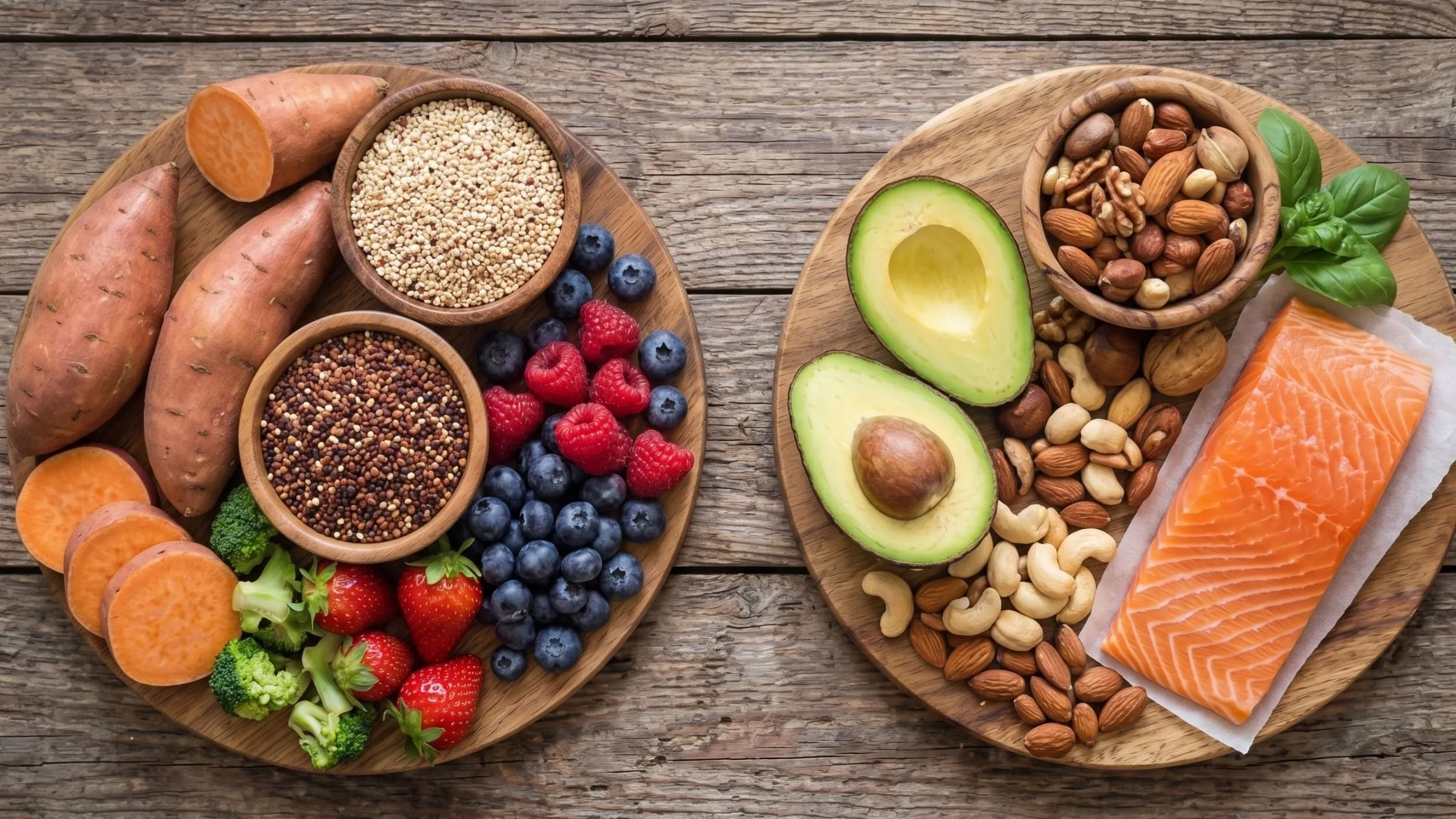
Two people can eat the exact same number of calories, with the same protein, and get completely different results — just because of how those calories are split between carbohydrates and fat. This is one of the more overlooked reasons why a plan that works for your friend doesn't work for you. It's not a flaw; it's individual metabolic variation, and once you understand which side you lean toward, everything else becomes a lot easier to dial in.
It's about which macronutrient your body handles more efficiently as a fuel source. Carb-tolerant people do better when carbohydrates make up a larger share of their intake — they burn them cleanly, energy is stable, and fat loss tends to move more smoothly when fat intake is kept in the lower end of the healthy range. Fat-tolerant people operate better on a higher proportion of dietary fat and tend to stall when carbs are too high relative to their needs. Neither is a problem — it's just individual metabolic variation.
The clearest way is through elimination and observation. If your calories are appropriate, your protein is adequate, and fat loss has stalled, try swapping some fat calories for carb calories while keeping the total the same — and watch what happens over three to four weeks. If things start moving, you're likely more carb tolerant. If they don't, try the reverse. This is exactly how one of our coaches identified his own pattern: his intake had drifted toward higher fats (all healthy — olive oil, avocado, cashews) and lower carbs, and nothing was moving. Swapping some of those fat calories for carb calories at the same total was the only change, and it was the entire unlock.
No — not at all. Healthy fats like olive oil, avocado, whole eggs, fatty fish, and nuts are beneficial regardless of your macro tolerance. The question isn't whether to eat them; it's how much relative to your other macronutrients. The standard recommended range for dietary fat is roughly 15–30% of total calories. If you're carb tolerant, you'd aim toward the lower end of that range (15–20%). If you're more fat tolerant, you might sit closer to 25–30%, with carbs adjusted downward accordingly.
Using a rough example: protein at around 40% of total calories (which is solid for body recomposition), fat at 15–20%, and carbohydrates filling in the remaining 40–45%. That's a higher-carb structure that works well for people who burn them efficiently. For someone more fat tolerant, you'd flip the fat and carb percentages — more fat, fewer carbs, same protein target. The protein anchor stays consistent either way; what changes is the carb-to-fat ratio.
Track your macros — not just calories — for two to three weeks without changing anything first, so you can see your current split clearly. If fat loss has stalled, look at whether your fat intake has quietly crept up. It happens easily with cooking oils, nut butters, cheese, and whole eggs, especially when you're not measuring. Try pulling fat down to the lower end of the healthy range and putting those calories into carbohydrates. Give it four weeks and see how your body responds. You might be surprised how simple the fix turns out to be.
Yes — because the deficit is just the baseline condition. Within that deficit, the split of your remaining calories still affects how your body responds. Two people in the same 500-calorie deficit can get different results based on how their macros are structured relative to their individual tolerance. Getting the deficit right is step one; optimizing the macro split within that deficit is the refinement that often breaks a stubborn plateau without requiring any change in total intake.
Calories matter, but the split of those calories matters too — and it's individual. If you're eating right, training consistently, and still stuck, look at your macro percentages before assuming something bigger is wrong. Sometimes trading fat calories for carb calories (or the reverse) is the entire unlock, with zero other changes needed. The only way to know which direction to go is to test it — and four weeks of honest tracking will tell you everything you need to know.
Answer 5 quick questions and get a personalized plan based on your current routine and medication schedule.
Question 1 of 5
Are you currently taking a GLP-1 medication?
Question 2 of 5
How often are you currently exercising?
Question 3 of 5
What does your workout routine mostly include?
Question 4 of 5
What is your biggest concern right now?
Question 5 of 5
When do you typically schedule your GLP-1 injection?
Your personalized plan is ready. Enter your name and email to see it now.
Please enter a valid email address.
No spam. Unsubscribe anytime.
The medication is doing its job on appetite and blood sugar. But without regular strength training, a significant portion of the weight you lose will be muscle, not just fat. That makes it harder to keep the weight off long-term and can leave you feeling weaker and more fatigued.
Where to focus first:
Want a personalized plan built around your medication schedule and current fitness level? We work with women on GLP-1s every day.
Book a Free Discovery CallYou are already moving, which puts you ahead of most people starting a GLP-1 protocol. The opportunity now is in the details: injection timing, exercise intensity relative to your dose schedule, and making sure your workout type matches your goal. Small adjustments here compound significantly over time.
Where to optimize:
Want a plan that accounts for your specific schedule, medication timing, and goals? That is exactly what we build for our clients.
Book a Free Discovery CallYou are already doing the most important things: exercising consistently and including strength work. At this stage, the gains come from progressive overload, precision nutrition timing, and making sure your recovery is keeping pace with your output. This is where a coach makes the biggest difference.
What to focus on now:
You are in a great position. A coach can help you make sure every workout and every meal is moving you forward. Let us talk.
Book a Free Discovery Call



.webp)


