Brian Abell
Exercise During Pregnancy: The Complete Trimester-by-Trimester Guide
Exercise
.webp)
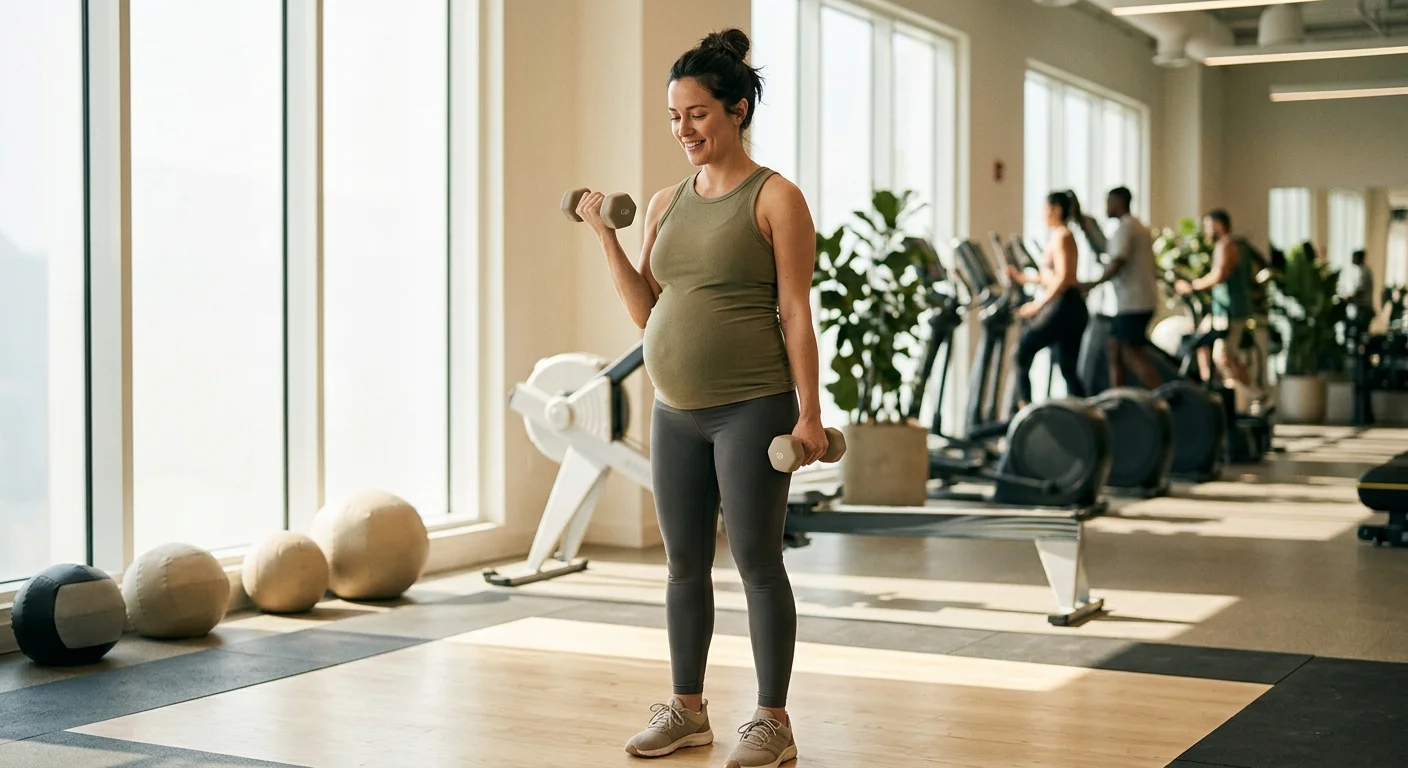
Two things happen when a woman finds out she's pregnant and she's been working out regularly. Either she worries that exercise might hurt the baby and starts scaling back everything, or she worries she won't be able to keep training and feels a kind of grief about it before anything has even changed. Both reactions make sense. And both tend to lead people toward the wrong conclusion.
The research on this is pretty clear. ACOG's current guidelines recommend at least 150 minutes of moderate-intensity exercise per week throughout an uncomplicated pregnancy, the same target they recommend for non-pregnant adults. Research has not found that exercise increases miscarriage risk in healthy pregnancies, and studies have not identified a link to preterm labor or impaired fetal development in uncomplicated cases. What research does consistently show is that it may reduce gestational diabetes risk, help limit excessive weight gain, improve sleep, and, in many studies, shorten active labor.
That said, pregnancy changes your body in ways that matter for how you train. Your joints loosen. Your center of gravity shifts. Your cardiovascular system is working harder than normal even when you're sitting still. Those changes don't mean stop. They mean modify. Here's what that actually looks like, trimester by trimester.
For most pregnancies, yes. ACOG's Committee Opinion 804 lists absolute contraindications (conditions where exercise is restricted) and relative contraindications (conditions requiring physician clearance). If you don't have any of those, you have a green light.
The conditions that warrant an OB conversation before continuing to exercise include things like placenta previa, incompetent cervix, persistent bleeding, severe anemia, and uncontrolled hypertension. If you have any of those or your OB has flagged your pregnancy as high risk, that conversation needs to happen before you do anything else. For everyone else, continuing or starting a moderate exercise routine is generally encouraged, not just permitted.
From a training standpoint, the first trimester often looks more like a fatigue and symptom management problem than an exercise modification problem. The baby is tiny. Your belly hasn't changed. But your body is doing something enormous: building a placenta, dramatically increasing blood volume, and flooding itself with hormones. All of that costs energy, and most people feel it as exhaustion, nausea, or both.
For women who are already training, the honest advice is: do what you can. If you normally run four days a week and you can barely get off the couch, three short walks is a win. If your energy holds, your normal routine is generally fine. There's no need to add extra caution to workouts in the first trimester for most people. The adjustment isn't about the exercises. It's about managing your expectations around effort and output.
One thing worth knowing early: relaxin, the hormone your body produces to loosen the ligaments around your pelvis for delivery, starts rising in the first trimester. It affects all your joints, not just your pelvis. ACOG notes that increased joint laxity during pregnancy raises injury risk, particularly with high-impact activity and extreme ranges of motion. You don't need to overhaul anything yet. A deep squat or a loaded hip stretch that felt fine before may feel different now, and pushing through it just because you used to doesn't make sense.
For most women, yes, and usually in a good way. Nausea tends to ease. Energy comes back. The belly is present but not yet big enough to significantly change mechanics or stamina. Many of our clients describe weeks 14 through 24 as a period where they feel almost normal, sometimes better than normal, in their workouts.
This is a good window to get consistent and to build habits around things like pelvic floor engagement and pre-bracing before heavy movements. Those habits become more important as the pregnancy progresses, and learning them when you still feel good makes them easier to internalize. Pelvic floor work during pregnancy isn't just about Kegels. It's about understanding how to create abdominal pressure safely so you're not straining structures that need to hold up for the long haul.
On the topic of intensity: the old 140 BPM heart rate ceiling that circulated for decades has been retired. Current ACOG guidance recommends using the talk test instead. If you can carry on a conversation while exercising, you're in a reasonable range. If you can't get out a full sentence, back off. This is more practical than chasing a number on a monitor, and it adjusts naturally as your cardiovascular demand shifts throughout the pregnancy.
One modification that becomes relevant in the second trimester: lying flat on your back. The concern is that the weight of the uterus can compress the inferior vena cava, the large vein that returns blood to your heart, which can reduce circulation to both you and the baby. This generally becomes a meaningful consideration around 20 weeks. Before that, your body will usually signal discomfort before anything problematic happens. After 20 weeks, the guidance is to avoid sustained back-lying positions during workouts. Exercises like the bench press and floor-based ab work get modified or swapped for incline or seated alternatives.
Third trimester training is less about what exercises you're doing and more about how your body is responding to them day to day. Some days a squat feels fine. Other days, especially if you're full from a meal or had a rough night's sleep, it feels like too much. Learning to train by feel rather than by a fixed plan becomes more important here than at any other point.
The mechanical changes accumulate. Your center of gravity has shifted forward, which affects balance and makes single-leg exercises riskier. Round ligament pain, a sharp or achy sensation in the lower abdomen or hip area as the ligaments supporting the uterus stretch, is common and usually harmless, but it's a signal to modify rather than push through. Shortness of breath returns, this time because the growing uterus presses up into the diaphragm, limiting lung expansion. Braxton Hicks contractions may show up during or after exercise. They're generally normal, but sustained or painful contractions during a workout are a reason to stop and check in with your OB.
Balance and pelvic girdle pain often require dropping single-leg movements in the later weeks. Heavy loaded squats and deadlifts may stay in the program but at reduced loads and with careful attention to how you're bracing. The goal in the third trimester is staying active, maintaining what you've built, and preparing your body for labor. Not setting new PRs.
For a full breakdown of what specifically to adjust as your belly grows, see our third trimester exercise modification guide.
It shifts twice, and understanding why helps you not panic when it happens. In the first trimester, breathlessness during exercise is mostly a cardiovascular response. Your blood volume increases by roughly 40-50% during pregnancy, and your heart and lungs are working harder to keep up with that demand, even at rest. Effort that used to feel easy can feel harder than expected.
In the second trimester, many women get a window of relative relief. Once the body adapts to the cardiovascular demands of early pregnancy, breathing during exercise can feel close to normal for a few weeks. That window doesn't last forever. By the third trimester, the uterus is pressing upward into the lungs, mechanically reducing how much air you can take in per breath. This shortness of breath is structural, not cardiovascular, and it doesn't go away until after delivery. Adjusting workout intensity to accommodate it is the practical solution, not a sign that something is wrong.
Relaxin is the primary driver of joint changes. It's a hormone that loosens the connective tissue around the pelvis to prepare for delivery, but it affects all the joints in the body, including the knees, ankles, and shoulders. This creates what feels like extra range of motion, but it's passive looseness, not genuine flexibility, and you're more susceptible to strains and sprains at those end ranges than you normally would be. Stretching should be kept within comfortable ranges during pregnancy, not pushed.
Balance shifts because your center of gravity moves forward as your belly grows. Your body compensates by changing how you hold your pelvis and spine, and those compensations affect gait, stability during single-leg exercises, and how much core control you can generate. This is one of the reasons that single-leg work, box jumps, and other activities requiring precise balance get modified or dropped in later pregnancy. The risk isn't that the exercise itself is dangerous. It's that a stumble or missed step carries more consequence when you're pregnant.
Yes. ACOG lists clear stop-and-call-your-provider signals. These include: vaginal bleeding, regular painful contractions, amniotic fluid leakage, shortness of breath before starting exercise (not during), dizziness or feeling faint, chest pain, calf pain or swelling, headache, and decreased fetal movement. If any of these show up during a workout, stop. Don't try to walk it off or see if it passes.
Braxton Hicks contractions are different. They're irregular, painless or mildly uncomfortable, and usually stop when you change position or drink water. If what you're feeling doesn't match that description, stop exercising and contact your provider.
It looks different at 8 weeks than at 32 weeks. The through-line is that you're working with your body's current capacity, not against it. Strength work stays in throughout most pregnancies, with load and exercise selection adjusting as needed. Cardiovascular work shifts toward lower-impact options as the belly grows. Mobility and pelvic floor work get added in and become more intentional as you move into the second and third trimesters.
The one-size-fits-all prenatal workout plans you'll find online aren't wrong, exactly, but they're not built for your body at your specific week of pregnancy with your specific history. A structured prenatal workout plan built for your trimester will account for things like pelvic floor status, any current pain or discomfort, your training history, and what your OB has said. That's where you actually get results and stay safe, not from a generic PDF.
If you're wondering about weight training specifically, we have a full breakdown of that too: is it safe to lift weights during pregnancy? And if the concern you're sitting with is more fundamental than that, like whether exercise can cause a miscarriage, we address that directly as well: will exercise cause a miscarriage or preterm labor?
The message isn't "exercise is fine, go do whatever you want." It's "exercise is well-supported by research and beneficial for most pregnant women in uncomplicated pregnancies, and the modifications you need change as your pregnancy progresses." Some weeks feel great. Some weeks you're barely getting through a walk. Both are normal.
If you've been active, keep going with adjustments. If you haven't been active, starting with walking and light strength work is appropriate and well-supported by the research. If you're high risk, your OB's guidance comes first, full stop.
The women we work with who do best during pregnancy aren't the ones who train hardest. They're the ones who stay consistent, communicate with their coach and their provider, and don't let a bad week convince them to quit entirely. That last part matters more than any specific exercise selection.
Sources
ACOG Committee Opinion No. 804 (2020). Physical Activity and Exercise During Pregnancy and the Postpartum Period. Obstetrics & Gynecology. ACOG
Mottola MF et al. (2018). 2019 Canadian Guideline for Physical Activity throughout Pregnancy. British Journal of Sports Medicine. 52(21):1339-1346. PubMed
Davenport MH et al. (2018). Impact of prenatal exercise on neonatal and childhood outcomes: a systematic review and meta-analysis. British Journal of Sports Medicine. 52(21):1386-1396. PubMed
Evenson KR et al. (2014). Summary of International Guidelines for Physical Activity After Pregnancy. Obstetrical & Gynecological Survey. 69(7):407-14. PubMed


.webp)


