
Cassie Therrien-Abell
Is It Too Late to Start Working Out During Pregnancy?
Exercise
.webp)
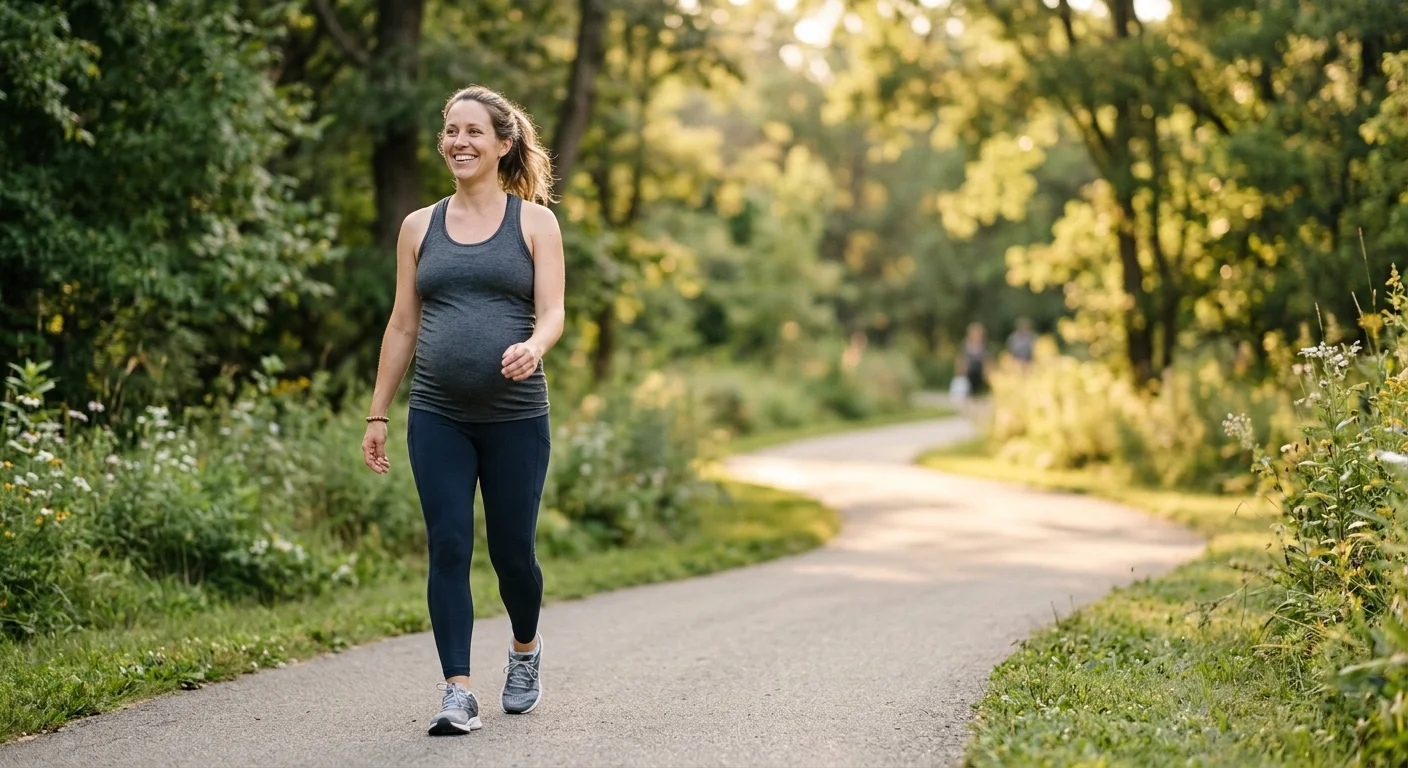
I hear some version of this a lot: "I was so sick in the first trimester I didn't do anything, and now I'm 16 weeks and I feel like I've already missed my window." Or: "I wasn't active before I got pregnant, so is it even safe to start now?" Both of those questions come from a real place, and both are based on a misconception I want to clear up.
There is no window you've missed. ACOG's current guidelines support beginning a moderate exercise program during pregnancy even if you weren't active beforehand, provided your pregnancy is uncomplicated and your OB hasn't given you specific restrictions. The research doesn't say "this only works if you started in week six." It says movement benefits you and your baby regardless of when you begin.
The guilt around a sedentary first trimester is one of the things I actively push back against with clients. Nausea, exhaustion, and just-surviving-the-day are legitimate reasons to not be in the gym. That's not failure. That's biology. What matters is what you do from here.
The 2019 Canadian Guideline for Physical Activity throughout Pregnancy recommends 150 minutes of moderate-intensity exercise per week across all trimesters, and it explicitly supports beginning that program in the second or third trimester for women who weren't active in the first. The benefits don't require a head start.
Research on those benefits includes: lower rates of gestational diabetes and preeclampsia, reduced excessive weight gain, better sleep, improved mood, and, in many studies, shorter active labor. A systematic review of prenatal exercise outcomes found that babies born to active mothers also showed lower rates of macrosomia (large birth weight) and lower cord blood insulin levels. These aren't marginal findings, and they're consistent across multiple studies.
The starting point matters less than the consistency. Ten to 15 minutes of walking a day is not a consolation prize. For someone who has been sedentary, it's genuinely where you start, and it counts.
Often yes, and there are real physiological reasons for that. Your blood volume has increased substantially, your cardiovascular system is already working harder than normal at rest, and depending on how far along you are, you may be carrying extra weight in a way that changes your mechanics. Exercise that would feel easy at baseline can feel harder during pregnancy.
This is not a sign that you can't handle it. It's a sign that your baseline has shifted and your expectations should shift with it. Perceived effort is a more useful guide than numbers on a treadmill or a heart rate monitor. If you can hold a conversation, you're at an appropriate intensity. If you're gasping, ease off.
Walking. Seriously. It sounds underwhelming, but it's one of the most well-studied forms of prenatal exercise, and it checks all the boxes: low joint stress, appropriate cardiovascular load, no equipment needed, and easy to adjust for how you're feeling that day. Start with 10 to 15 minutes and build from there.
Once walking feels comfortable, adding two short sessions of light strength work per week is appropriate. Bodyweight movements, resistance bands, and lighter dumbbell work are all reasonable starting points. The focus early on should be on learning how to move with control rather than chasing load or intensity.
What you don't need to do: jump into prenatal yoga classes every day, sign up for a swim program, try to replicate what you see on social media, or set any benchmarks for yourself based on what other pregnant women are doing. Your starting point is your starting point, and it's fine.
A few categories are worth steering clear of regardless of experience level. Contact sports and activities with a high fall risk (like skiing, horseback riding, and certain martial arts) are generally avoided during pregnancy because of the risk of abdominal trauma. Hot yoga is another one to skip. Your core temperature rises during exercise, and maintaining safe body temperature is more challenging during pregnancy. The concern is elevated maternal core temperature, and very hot environments like hot yoga studios make it harder to regulate body heat during pregnancy. Your OB can advise based on your specific situation.
For someone just starting out, the bigger practical concern is usually form and loading, not specific exercises to avoid. Moving with poor mechanics under even light load can cause strain. That's why having a coach who understands prenatal modifications matters more at the beginning than it does later, when you've already built good habits.
Less than you think. The research on prenatal exercise benefits doesn't sort outcomes by pre-pregnancy fitness level. What it consistently shows is that moving during pregnancy helps, full stop. You don't need a fitness baseline to start seeing those benefits. You need consistency and appropriate intensity, which are both entirely achievable regardless of where you're starting from.
What I'd push back on is the idea that your only goal during pregnancy should be "don't lose too much ground." The women I work with who start exercising during pregnancy, even late, often come out of it with habits, body awareness, and pelvic floor and core function that serves them far better postpartum than if they'd done nothing. That's not nothing. That's a real outcome.
A two-minute assessment of your pelvic floor with a qualified prenatal coach or pelvic floor specialist. Not because anything is wrong, but because the pelvic floor is the piece most beginners overlook and most regret not starting earlier. Understanding how to engage and relax it, and how to connect that to your breath and your core bracing, sets a foundation that affects every other movement you'll do for the rest of your pregnancy and into postpartum recovery.
From there: walking, light strength work, and showing up consistently. That's the whole program for most people starting from zero. Read the full pregnancy exercise guide if you want to understand what the full picture looks like across all three trimesters, or see a sample prenatal workout plan built week by week. Either way, the first step is just starting.
Sources
ACOG Committee Opinion No. 804 (2020). Physical Activity and Exercise During Pregnancy and the Postpartum Period. Obstetrics & Gynecology. ACOG
Mottola MF et al. (2018). 2019 Canadian Guideline for Physical Activity throughout Pregnancy. British Journal of Sports Medicine. 52(21):1339-1346. PubMed
Davenport MH et al. (2018). Impact of prenatal exercise on neonatal and childhood outcomes: a systematic review and meta-analysis. British Journal of Sports Medicine. 52(21):1386-1396. PubMed

.webp)


